Online or In-Person Tutoring? Which One Fits Your Child
6 Aug 2026

The question we get most often: which is better, online tutoring or in-person?
And that, frankly, is the wrong question. There is no format that is better in the abstract, just as there is no medicine that is better in the abstract. There is a format that suits a particular child, in a particular subject, in a particular family's circumstances.
The right question is: which suits your situation? That is what we will answer across four clear factors, along with a third option most parents overlook even though it may be the smartest of the three.
In-person lessons: when do they genuinely win?
The strength of in-person tutoring is one thing no screen replaces: full presence.
A tutor sitting in front of a child sees their paper, their pencil and their eyes. They catch the moment of distraction before it turns into being lost, they notice how numbers are written, and the hesitation in the hand before an answer. These are small signals that make the difference in diagnosis, especially with younger children.
In-person usually wins in three situations: children in the early primary years, foundation work of any kind, and the student who gets distracted quickly in front of a device. If your child is one of those, skip the format debate and focus on choosing the tutor.
Online tutoring: when is it the smarter choice?
The strength of online is something in-person cannot offer: reach.
The best physics tutor for a secondary student may be in another city. Online, distance disappears, and your choice of tutors widens from your neighbourhood to the whole Kingdom. On top of that comes a real saving in time and cost, because nobody is paying for the journey.
Online usually wins with organised middle and secondary students, and in conversational subjects such as English revision and speaking practice. It also wins when the tutor you want is far away, and with packed schedules that cannot absorb travel.
The third option many overlook: a lesson in a public place
Between the home and the screen sits a third option growing quietly: holding the in-person lesson in a public library, a quiet cafe, or on a university campus.
This solves the hardest equation for many families: you want the advantages of in-person, and you do not want to bring a stranger into your home. A public place gives you the tutor face to face, in a neutral setting that reassures both sides, and it usually suits middle school, secondary and university students.
There is an extra benefit few people notice: some students concentrate better outside the house than inside it. Home has devices, siblings and a bed; the library has nothing but the lesson.
Factor one: your child's age and attention span
The rough rule we see hold in most cases:
Early primary leans clearly towards in-person. A child's concentration in front of a screen evaporates quickly, and learning at that age runs through the hand and through movement, not through the eyes alone.
Years four to six are a middle zone, decided by the child's own temperament. Try it and watch.
Middle and secondary students handle online comfortably; in fact many secondary students prefer it, because it is quicker and less awkward than a lesson in front of the family.
Factor two: the nature of the subject
Subjects are not equal in front of a screen.
Maths at foundation level needs paper, a pencil, and a tutor who sees the steps as they are written, so in-person usually suits it better. Revising secondary maths with a student who already has the basics, on the other hand, works smoothly at a distance.
English speaking and listening are among the most successful subjects online; the screen takes nothing away from a conversation. But foundation reading and writing for young children goes back to the in-person rule.
The practical summary: the closer the subject sits to paper and hand, the more it leans to in-person. The closer it sits to conversation and explanation, the wider it opens to online.
Factor three: time, travel, and their real cost
Work it out honestly once, then decide.
An in-person lesson with a tutor crossing the city means at least an extra hour that you pay for one way or another, either in the price or in having fewer nearby tutors to choose from. An online lesson removes that cost entirely, which is why its published prices are usually lower, as we set out in our guide to private tutoring prices.
And for families running more than one child and more than one lesson a week, the travel difference alone can settle the decision.
Factor four: safety and the family's comfort
Honesty here is more useful than politeness: letting a stranger into your home is a decision no family takes lightly, and that concern is entirely legitimate.
Each format has its answer. An online lesson removes the question at the root. A lesson in a public place gives you in-person tutoring without opening your front door. And a home lesson becomes reassuring when the tutor's identity is verified and their qualification reviewed, with all communication inside a platform and no personal numbers exchanged. Those are the signs we set out in our guide to choosing a trustworthy tutor.
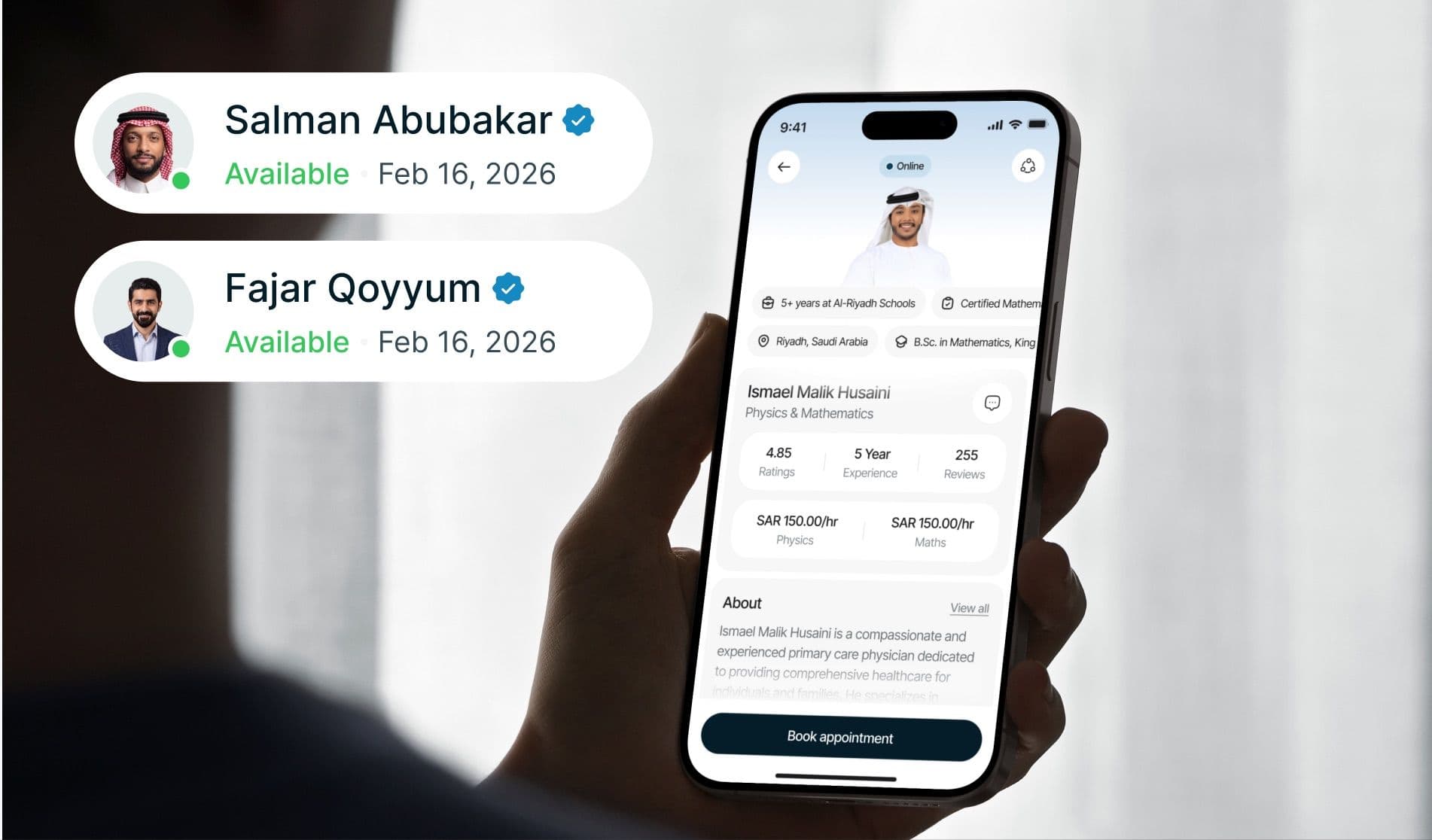
On Mualimi we made the lesson location an open choice set by the family and tutor together: the home, the tutor's location, or a public place. The format follows your comfort, not the other way around.
A quick comparison table
- Early primary and foundation work — In-person: Usually the better fit · Online: Hard with young children
- Middle and secondary — In-person: Excellent · Online: Excellent and practical
- Breadth of tutor choice — In-person: Limited to your city · Online: The whole Kingdom
- Published cost — In-person: Usually higher · Online: Usually lower
- Time and travel — In-person: Needs arranging · Online: Zero travel
- Paper-and-pencil subjects — In-person: Strongest · Online: Needs a capable student
- Conversation and revision — In-person: Good · Online: Among the best fits
- Concern about a stranger at home — In-person: Real, and solvable · Online: Does not arise
How do you test before committing?
A decision on paper stays a guess until you test it. The smarter approach:
Book one trial lesson in the format you are leaning towards, and watch three things. Did your child stay mentally present for the whole session? Did they interact with the tutor or just listen? And what did they say afterwards, without you asking a leading question?
Then try the other format once if any doubt remains. Two trial lessons are far cheaper than a whole term in the wrong format. And do not commit to a large block of lessons before you feel settled.
In summary
Do not ask which is better; ask which suits your child's age, their subject, your family's schedule, and your own comfort. Young children and foundation work lean towards in-person, older students and revision open up to online, and a public place is a middle ground that deserves a place in your thinking.
And more important than the format is still the tutor. An excellent tutor online beats a weak tutor in your living room a thousand times over.
Browse verified tutors on Mualimi today and compare the lesson options available. Browsing is free, the price is published before booking, and changing tutor is always in your hands.
Frequently asked questions
It depends on age. Before roughly year four, a child's screen concentration is short and in-person suits better. After that it becomes fully effective, provided the student is organised and the tutor is comfortable with remote teaching tools.
Published prices for online lessons are usually lower, and the gap can reach a third of the price, because the tutor is not paying for travel time and its cost.
Yes, and it is a growing choice among families: a public library, a quiet cafe, or a university campus. It gives you the advantages of in-person without bringing a stranger home, and it suits middle and secondary students especially.
A device with a camera and clear audio, a stable internet connection, and a quiet space away from household distractions. A simple headset improves the session more than you would expect.
Foundation work in the early primary years leans clearly towards in-person, because the tutor needs to see the hand, the paper and the pronunciation up close. We cover this in our guide to foundation work in maths and English.
Mualimi6 Aug 2026