Private Tutoring Prices in Saudi Arabia 2026: The Honest Guide
9 Aug 2026
We will not open this guide with a false promise.
There is no single price for a private lesson in Saudi Arabia. Anyone who hands you one number and calls it the price is either selling something or does not know the market. Published private tutoring prices today run from around 40 riyals an hour online to more than 200 riyals for an in-person lesson with an experienced tutor.
That is a wide gap, but it is not random. Six factors decide where your price sits inside that range. Understand them and you will know the fair price for your situation before you negotiate with anyone.
The six factors that set the price
Year level. A primary lesson costs less than middle school, and middle school costs less than secondary. The further along the level, the more specialised the tutor needs to be, and the higher the price.
Subject. Maths, physics and chemistry usually price above the rest. The reason is simple: demand is higher and the number of tutors who genuinely command them is lower.
City and district. Prices in Riyadh and Jeddah sit above smaller cities. Within a single city, the price rises if the tutor has to travel a long way.
In-person or online. Online is usually cheaper, because it saves the tutor travel time and its cost. The published gap between the two formats can reach a third of the price. Which one actually suits your child? We work through that in our comparison of online and in-person tutoring.
Tutor experience. A tutor in their first year does not price like one with ten years and results they can prove. Documented experience is the most expensive thing you pay for, and it is usually worth it.
Number of lessons. A one-off lesson costs more than a regular commitment. Most tutors reduce the rate when you commit to a fixed weekly number.
Private tutoring prices: the published market ranges today
We collected the prices published on Saudi platforms and sites as they appeared in August 2026. These are prices published by their own sources, not prices we set, and they can change at any time.
- Mudarrebi: From 40 riyals an hour online, with monthly subscriptions from 590 riyals
- Lern: From 50 riyals per online lesson
- Hissa: 70 to 200 riyals per lesson depending on subject and level
- Home tutoring adverts on social platforms: Around 80 riyals for a primary lesson, around 100 riyals for middle and secondary
Notice something important in that table: the sources contradict each other. One platform says 40 and another says 200 for what looks like the same service. That contradiction is the clearest evidence of a market with no standard, and it is exactly why understanding the factors matters more than memorising the numbers.
Why do prices differ between cities?
The short answer: travel and competition.
In Riyadh and Jeddah, distances are long and the traffic is real. A tutor who spends an hour getting there and an hour getting back builds that time into the price, and rightly so. In smaller cities that cost falls, and the price falls with it.
Competition works in both directions. Big cities have more tutors, but they also have more demand, especially in exam season. That is why prices there do not drop despite the number of tutors.
The season moves the price too
There is a seventh factor that never appears in adverts but is felt in every household: timing.
Before final exams, and before the Qudurat and Tahsili dates, demand for tutors jumps all at once. The good tutor's calendar fills up, and whoever is still available raises their rate. Anyone who waits until the last month pays more and gets fewer options.
The practical rule here is simple. If you know your child will need support this term, start early. Booking early gets you the normal price and the better tutor at the same time; delay costs you both.
The difference between year levels
The rule the market publishes is this: each step up adds roughly 20 to 30 riyals to the lesson price.
Foundation and primary lessons are the cheapest, because their content is within reach of a large number of tutors. Secondary lessons cost more, because the subjects are specialised and because they are usually tied to something valuable: a GPA, Qudurat, or Tahsili.
And here is a point many people miss. An expensive secondary lesson can work out cheaper over time than a string of cheap scattered lessons, on one condition: that it is with a tutor who knows exactly what a student at that level needs.
The most expensive subjects, and why
Maths first, then physics and chemistry, then English.
The reason is not that these subjects are harder in themselves, but that they are cumulative. A student who missed the fundamentals of maths in middle school needs a tutor who repairs years of gaps, not one who explains this week's lesson. That kind of repair takes experience, and experience prices itself.
Humanities subjects usually cost less, because the tutor's effect on them is less decisive and because there are more self-study alternatives.
English is a special case worth pausing on. Demand for it is not limited to school students; it includes university students, employees, and people preparing for tests such as STEP and IELTS. That broad demand keeps its prices high all year round, even outside school exam seasons.
Foundation lessons are a different animal from follow-up lessons, even where the price looks similar. A foundation tutor repairs old gaps and rebuilds from the ground up, which is slower and more precise work than explaining this week's material. So you may find a capable foundation tutor pricing above a follow-up tutor for a higher year level, and the difference is justified.
When is a price unreasonable?
Signs that a price is inflated:
- A high rate with no documented experience or verifiable reviews
- Insistence on a large number of lessons paid upfront before any trial lesson
- Tying the price to guaranteed grades, which is a promise no honest tutor can make
And signs that a price is suspiciously low:
- A rate far below everything published in the market for the same subject
- Vagueness about the qualification, or refusal to answer any question about it
- Rushing to close the agreement before you have finished asking
A very low price is not always an opportunity. Sometimes it is a signal that the seller knows their offer is not worth more.
The bigger question is not how much, but for what
When you compare tutors, do not compare bare numbers. Compare what stands behind each one.
Is the identity verified? Is the qualification real and reviewed? Are there reviews from previous families? Do you find out what happened in the lesson after it ends? We work through these signs one by one in our guide to choosing a verified private tutor.
A tutor at 120 riyals with all of those guarantees is genuinely cheaper than one at 90 with none of them. Because the real price of a failed lesson is not what you paid for it; it is the months your child lost before you realised.
Why you should know the price before booking, not after
The biggest flaw in the traditional market is not that prices are high. It is that they are absent.
With no published price, every agreement becomes a private negotiation. Your neighbour pays half what you pay for the same service, and neither of you knows. And when the price suddenly rises mid-term, there is nothing to point back to.
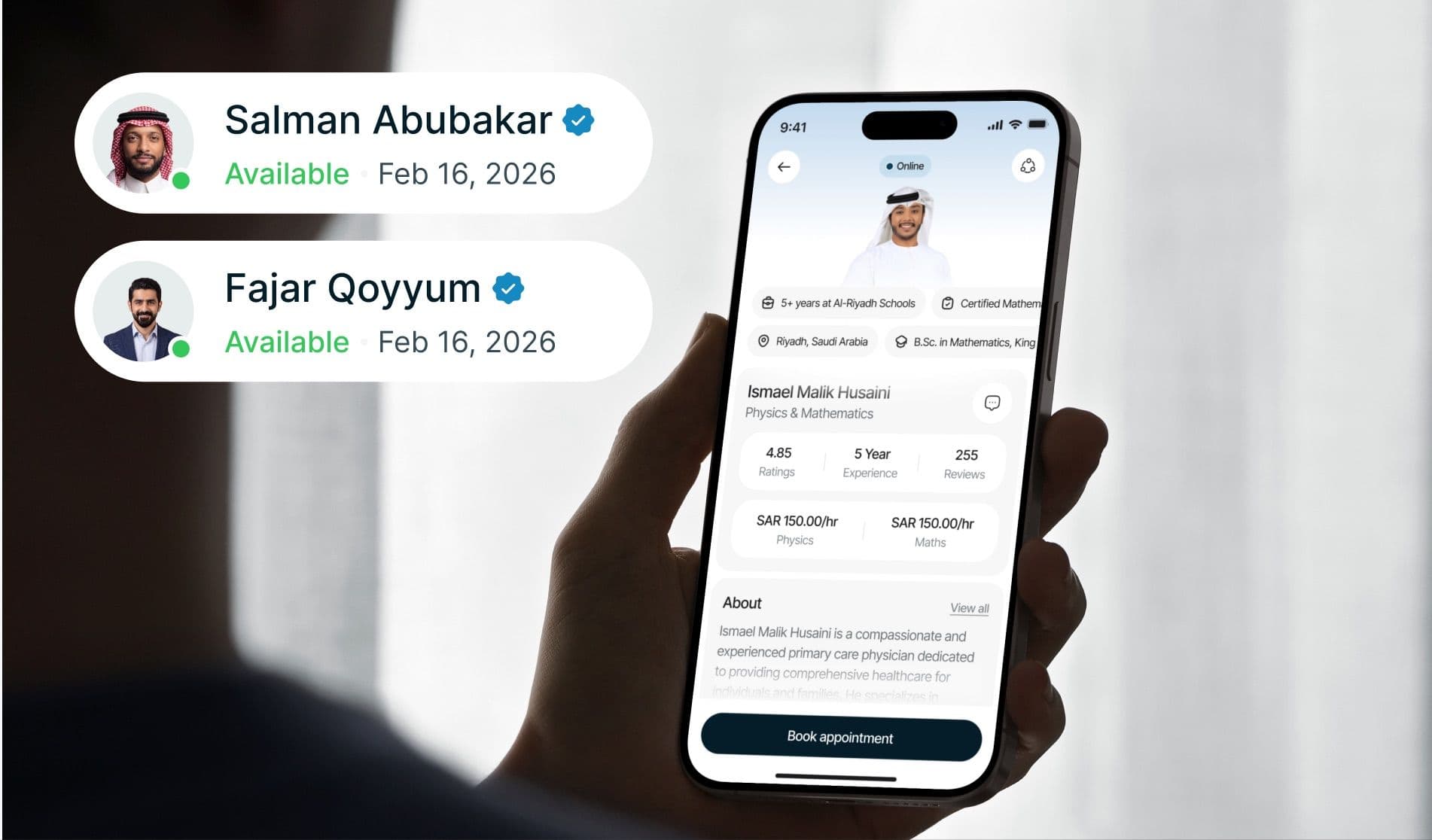
That is why we see publishing the price upfront as a matter of fairness rather than a technical detail. On Mualimi, every tutor's price is published on their profile before you book; you see it, compare it, then decide. Any addition, such as a travel cost, appears before you confirm rather than afterwards.
In summary
Do not look for the one correct price, because it does not exist. Look for the fair price for your situation: your child's level, the subject, your city, the lesson format, and the tutor's documented experience.
And keep one rule fixed: never pay someone you do not know, and never judge a tutor on price alone.
Browse verified tutors on Mualimi today and compare published prices for yourself. Browsing is free, and the price is in front of you before any commitment.
Frequently asked questions
Published market prices run from around 40 riyals an hour online to more than 200 riyals for an in-person lesson, depending on level, subject, city and the tutor's experience.
Primary lessons are the cheapest in the market, with circulating adverts quoting around 80 riyals for a home lesson. Online lessons usually sit below that.
Yes, and the published gap can reach a third of the price. An online lesson saves the tutor travel time and cost, and that shows up in the rate.
Documented experience first, then subject and level, then reviews and past results. A tutor who can prove their impact prices higher, and usually deserves to.
Not always. If a price is far below everything published in the market, ask why before you book. Verification and reviews matter more than saving a few riyals.
Mualimi9 Aug 2026